Students forget their marks in a few years. But when they learn about kindness, fairness, and other people’s struggles, it stays with them forever.
That’s the thinking behind Project Samvedna, RIS Gandhinagar’s dedicated initiative for empathy education and community service. It is within the Life Skills petal of the school’s 4 Petal Pedagogy. It puts students face-to-face with real needs in their own community.
If you’re a parent wondering how a CBSE school in Gandhinagar actually builds character, Project Samvedna is a good place to look.
What is Project Samvedna?
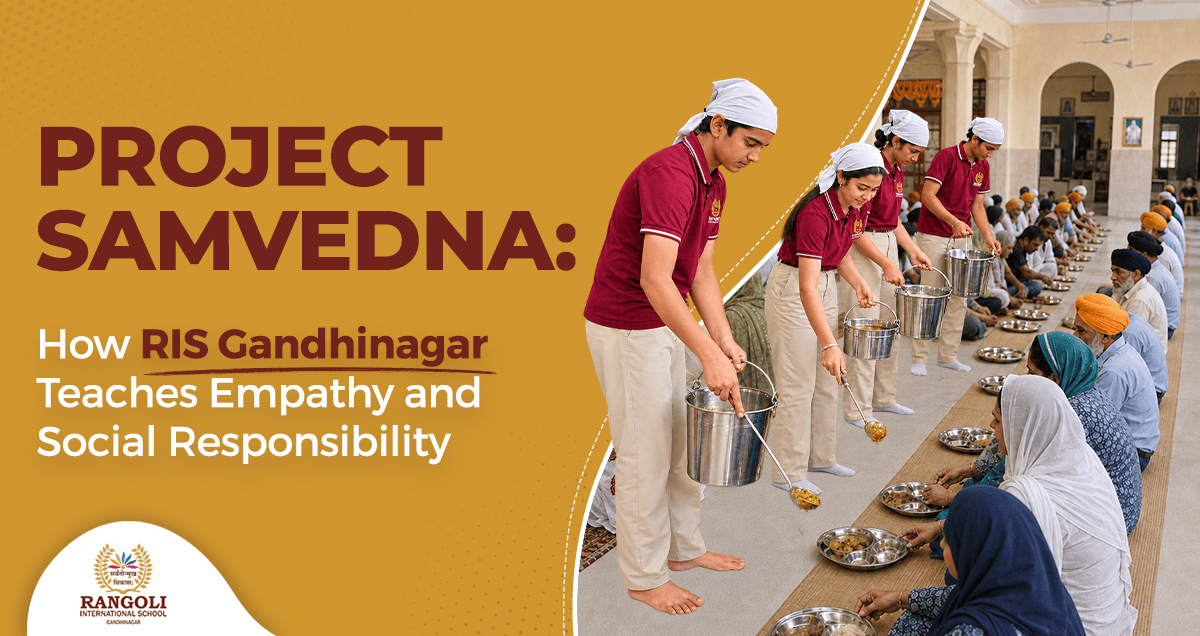
Samvedna translates to “empathy” or “compassion” in English. It is RIS Gandhinagar’s structured initiative for social responsibility. Through it, students take part in charitable activities such as distributing food, clothes, and essential items to underprivileged families in and around the community.
The project was launched as part of the school’s commitment to social responsibility. It gives students a direct way to connect with people whose circumstances differ from their own. It isn’t a one-off event tucked into the calendar. It’s treated as an ongoing part of how RIS Gandhinagar teaches children to think beyond themselves.
How Does Project Samvedna Help Build Empathy in Students?
Empathy isn’t something a child can memorise from a textbook. It has to be experienced. Project Samvedna is built around that idea, and it works through a few key mechanisms:
- Direct interaction: Students personally hand out food, clothes, and essentials, rather than simply donating items through a drop box.
- Real exposure to inequality: Seeing underprivileged families up close helps children understand challenges they may never have encountered at home or school.
- Reflection built into the process: Teachers guide students to discuss what they observed. It turns a single visit into a lasting lesson about kindness and awareness.
- Repetition over time: Because Project Samvedna runs as an ongoing initiative rather than a single event, empathy slowly becomes a habit.
By combining action with reflection, RIS Gandhinagar helps students move from simply feeling sorry for someone to genuinely understanding their situation and choosing to help.
What Impact Has Project Samvedna Had on the Local Gandhinagar Community?
The most immediate impact is practical: families in and around Gandhinagar have received food, clothing, and essential items they needed, directly from RIS students. But the ripple effect goes further.
- Underprivileged families receive tangible support, meeting immediate needs for food and clothing.
- Students carry the habit of giving beyond school, often influencing their own families to participate in similar acts of kindness.
- The wider RIS community becomes more socially aware, as parents, teachers, and students engage with local social issues together.
- A culture of giving takes root early, meaning today’s students are more likely to become community-minded adults tomorrow.
Community service program initiatives like this rarely make headlines. But for the families who receive support, and the children who learn to notice and respond to need, the impact is very real.
Why RIS Gandhinagar Built Empathy Into the Curriculum
Generally, schools cover values through assemblies or moral science periods. RIS Gandhinagar takes a more direct approach, weaving character building into a full initiative with a name, a structure, and a purpose.
This fits within the school’s broader Life Skills petal, which also includes programs like the Sanskar Module, a monthly initiative that introduces students to values such as gratitude and respect for elders. Project Samvedna complements this by turning values into action.
The reasoning is straightforward: children who are only taught about kindness in theory rarely carry it forward. Children who practise it and who see its impact are far more likely to make it part of who they are.
How Project Samvedna Fits Into RIS Gandhinagar’s Holistic Education Approach
Project Samvedna is one piece of a larger philosophy at RIS Gandhinagar that treats academics, sports, humanities, and life skills as equally important to a child’s growth. While Academics builds the mind and PE & Sports builds the body, initiatives like Project Samvedna build the ability to notice someone else’s struggle and choose to act.
This is part of what makes RIS Gandhinagar stand out among CBSE schools in the region: it doesn’t treat character building as a side activity. It’s built into the same structure that shapes report cards, sports days, and school assemblies.
Conclusion
Project Samvedna shows what character building looks like when a school treats it as seriously as academics. By giving students real opportunities to give, reflect, and grow, RIS Gandhinagar helps shape children who are not just academically capable, but genuinely aware of the world around them.
FAQs
1. How does Project Samvedna help build empathy in students?
Students personally take part in distributing food, clothing, and essentials to underprivileged families, followed by classroom reflection. This direct exposure and guided discussion help children understand real hardship rather than just hearing about it.
2. What impact has Project Samvedna had on the local Gandhinagar community?
Underprivileged families in and around Gandhinagar have received essential support such as food and clothing. Beyond material help, the project has also encouraged a broader culture of giving among students, families, and the wider RIS community.
3. Which students at RIS Gandhinagar take part in Project Samvedna?
Project Samvedna activities are designed to be age-appropriate, with students across grades participating in ways suited to their age, from simple giving activities for younger children to more involved community outreach for older students.
4. How often does Project Samvedna run at RIS Gandhinagar?
It runs as an ongoing initiative under the school’s Life Skills petal rather than a single annual event. Students engage with community service and empathy-building activities at multiple points throughout the school year.
5. Can parents get involved in Project Samvedna?
Parents are often encouraged to support these initiatives, whether through contributing essential items or reinforcing the values at home, since lasting empathy grows strongest when it’s practised both at school and at home.